《柳叶刀》: 赛沃替尼联合奥希替尼治疗EGFR突变阳性、MET扩增的晚期非小细胞肺癌的SACHI中国III期研究的中期分析数据
Savolitinib plus osimertinib versus chemotherapy for advanced, EGFR mutation-positive, MET-amplified non-small-cell lung cancer in China (SACHI): interim analysis of a multicentre, open-label, phase 3 randomised controlled trial
Prof Shun Lu, Prof Jie Wang, Prof Nong Yang, Dongqing Lv, Lijuan Chen, Prof Lin Wu, Xingya Li, Longhua Sun, Yongfeng Yu, Bo Jin, Lin Yang, Yubiao Guo, Haipeng Xu, Tienan Yi, Aiping Zeng, Xiaorong Dong, Jianhua Chen, Ziping Wang, Hongrui Niu, Ying Cheng, Pinhua Pan, Pengbo Deng, Hongming Pan, Xuhong Min, Jun Bai, Laiyu Liu, Tongmei Zhang, Juan Li, Songhua Fan, Michael M Shi, Prof Tony Mok, Weiguo Su on behalf of the SACHI Study Group
Summary
Background
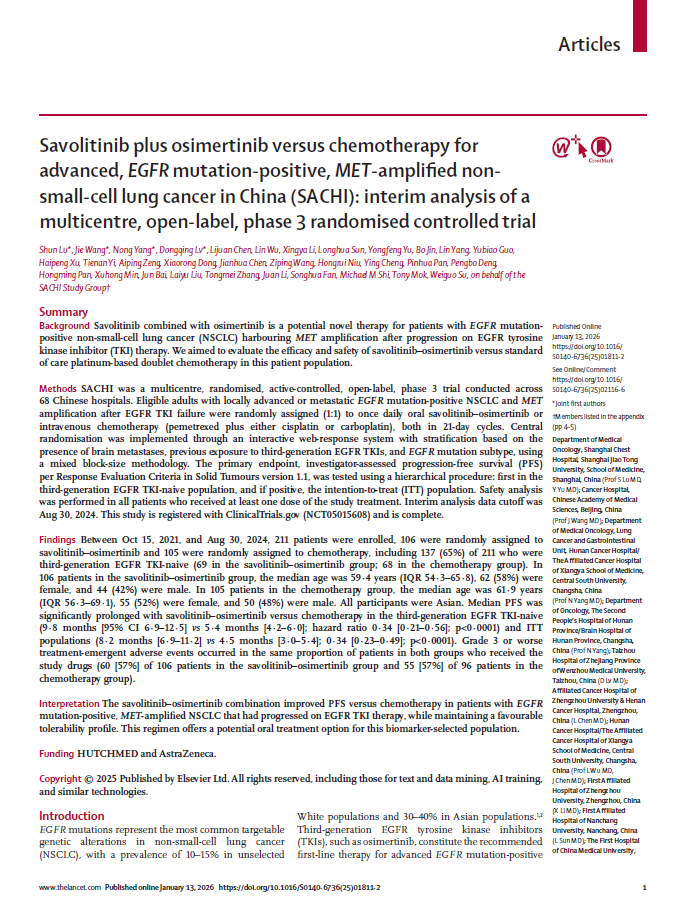
Savolitinib combined with osimertinib is a potential novel therapy for patients with EGFR mutation-positive non-small-cell lung cancer (NSCLC) harbouring MET amplification after progression on EGFR tyrosine kinase inhibitor (TKI) therapy. We aimed to evaluate the efficacy and safety of savolitinib–osimertinib versus standard of care platinum-based doublet chemotherapy in this patient population.
Methods
SACHI was a multicentre, randomised, active-controlled, open-label, phase 3 trial conducted across 68 Chinese hospitals. Eligible adults with locally advanced or metastatic EGFR mutation-positive NSCLC and MET amplification after EGFR TKI failure were randomly assigned (1:1) to once daily oral savolitinib–osimertinib or intravenous chemotherapy (pemetrexed plus either cisplatin or carboplatin), both in 21-day cycles. Central randomisation was implemented through an interactive web-response system with stratification based on the presence of brain metastases, previous exposure to third-generation EGFR TKIs, and EGFR mutation subtype, using a mixed block-size methodology. The primary endpoint, investigator-assessed progression-free survival (PFS) per Response Evaluation Criteria in Solid Tumours version 1.1, was tested using a hierarchical procedure: first in the third-generation EGFR TKI-naive population, and if positive, the intention-to-treat (ITT) population. Safety analysis was performed in all patients who received at least one dose of the study treatment. Interim analysis data cutoff was Aug 30, 2024. This study is registered with ClinicalTrials.gov (NCT05015608) and is complete.
Findings
Between Oct 15, 2021, and Aug 30, 2024, 211 patients were enrolled, 106 were randomly assigned to savolitinib–osimertinib and 105 were randomly assigned to chemotherapy, including 137 (65%) of 211 who were third-generation EGFR TKI-naive (69 in the savolitinib–osimertinib group; 68 in the chemotherapy group). In 106 patients in the savolitinib–osimertinib group, the median age was 59·4 years (IQR 54·3–65·8), 62 (58%) were female, and 44 (42%) were male. In 105 patients in the chemotherapy group, the median age was 61·9 years (IQR 56·3–69·1), 55 (52%) were female, and 50 (48%) were male. All participants were Asian. Median PFS was significantly prolonged with savolitinib–osimertinib versus chemotherapy in the third-generation EGFR TKI-naive (9·8 months [95% CI 6·9–12·5] vs 5·4 months [4·2–6·0]; hazard ratio 0·34 [0·21–0·56]; p<0·0001) and ITT populations (8·2 months [6·9–11·2] vs 4·5 months [3·0–5·4]; 0·34 [0·23–0·49]; p<0·0001). Grade 3 or worse treatment-emergent adverse events occurred in the same proportion of patients in both groups who received the study drugs (60 [57%] of 106 patients in the savolitinib–osimertinib group and 55 [57%] of 96 patients in the chemotherapy group).
Interpretation
The savolitinib–osimertinib combination improved PFS versus chemotherapy in patients with EGFR mutation-positive, MET-amplified NSCLC that had progressed on EGFR TKI therapy, while maintaining a favourable tolerability profile. This regimen offers a potential oral treatment option for this biomarker-selected population.
Funding
HUTCHMED and AstraZeneca.
Trial Registration
ClinicalTrials.gov Identifier: NCT05015608
Citations and Links
Please follow the link below to access the publication:
DOI: 10.1016/S0140-6736(25)01811-2
Link to article: https://www.thelancet.com/journals/lancet/article/PIIS0140-6736(25)01811-2/abstract